AI folk-tale preservation platform
Challenge submissionKatha
An IBM AI Builders Challenge project for recording oral folk tales and transforming rough voice or text submissions into preserved, translated, illustrated, and printable story formats.
- My role
- Full-stack developer — IBM AI challenge project
- Development status
- Challenge submission
- Intended users
- People preserving stories shared by relatives or community members
The context
Problem being solved
Oral stories can disappear when they live only in memory and are not recorded, written down, or passed to another generation.
Audience
Intended users
- People preserving stories shared by relatives or community members
- Readers exploring folk tales across languages and places
- Educators, families, and community storytellers
My role and contribution
Full-stack developer — IBM AI challenge project
- Contributed across the full-stack build as part of the documented challenge team.
- Worked on the Next.js experience, Supabase-backed story workflows, and AI-assisted text and image pipeline.
- Helped connect voice capture, audio storage, translation, illustration, mapping, community, and printable story formats.
Development status
The project was built for the IBM AI Builders Challenge in July 2026 and is presented as a challenge submission rather than a production publishing platform.
Main features
Voice or text story capture with audio preservation, cleanup, translation, tagging, and multilingual reading.
Generated cover art, illustrated children's books, comic scripts, read-aloud support, and printable PDF export.
Story maps, related-story chains, community memories, multiple sign-in options, and moderation tools.
Technical architecture
A swappable AI adapter sits between the application and text or image generation, while Supabase manages identity, story data, and preserved audio.
- 01
Capture and reading
Next.js + Web Speech APIs
Accepts text or dictated stories and supports multilingual reading and read-aloud output.
- 02
AI orchestration
Swappable application adapter
Routes cleanup, translation, tagging, reimagining, and illustration requests.
- 03
Creative services
Pollinations AI
Generates text transformations, cover art, and book illustrations.
- 04
Preservation layer
Supabase
Stores stories, community records, identities, permissions, and original voice audio.
Technology breakdown
A recruiter-focused view of the main technical responsibilities and service boundaries.
Frontend technology
Next.js 15, TypeScript, Tailwind CSS, shadcn/ui, and Magic UI support story capture, reading, maps, and creative formats.
- Responsive story submission and reading flows
- Illustrated book, comic, translation, audio, and PDF experiences
- Leaflet-based origin map and community interaction views
Backend technology
Next.js API routes and a single swappable AI function coordinate story processing and generated formats.
- Central adapter isolates the application from the current AI provider
- API routes coordinate cleanup, translation, tagging, reimagining, and image generation
- Server-side workflows support audio upload and illustrated PDF export
Database and storage
Supabase Postgres stores application data, while Supabase Storage preserves original voice recordings.
- Postgres records stories, users, community memories, and related-story chains
- Row Level Security protects application records
- Storage retains original storyteller audio alongside written content
External integrations
Text, image, speech, storage, and geocoding services support the preservation workflow.
- Pollinations AI text and image generation
- Browser Web Speech and Speech Synthesis APIs
- OpenStreetMap Nominatim and Leaflet
Authentication and security
Supabase Auth supports several participation modes while RLS and moderation controls protect platform data.
- Google OAuth, magic-link, and anonymous participation
- Row Level Security policies protect database access
- Admin tools support moderation of stories, community memories, and users
Testing, accessibility and performance
Testing approach
- The repository provides local development and production-build workflows.
- Manual scenarios should cover typed and dictated input, audio upload, translation, image generation, read-aloud, mapping, authentication modes, and PDF output.
- Failure scenarios should cover unavailable AI responses, interrupted uploads, unsupported speech features, and incomplete generated content.
Accessibility considerations
- Preserve a complete text experience when speech input, audio, generated imagery, or maps are unavailable.
- Provide meaningful alternative text for generated story artwork.
- Keep language selection, audio playback, and story navigation keyboard accessible.
- Use clear content warnings and moderation states for community submissions.
Performance considerations
- Defer illustration, map, audio, and PDF code until those experiences are requested.
- Avoid blocking story capture while slower AI generation work completes.
- Optimise generated images and audio delivery while preserving useful quality.
Learning and next steps
What I learned
- AI output works best when it supports preservation without replacing the original voice and source story.
- A swappable service boundary makes an AI workflow easier to change and maintain.
- Creative generation needs clear loading, failure, and review states.
What I would improve next
- Add automated tests around story transformations, storage permissions, and export workflows.
- Add provenance and reviewer controls for AI-edited or generated content.
- Test the preservation workflow with storytellers and cultural organisations.
Project gallery
Screenshots from the current project build.
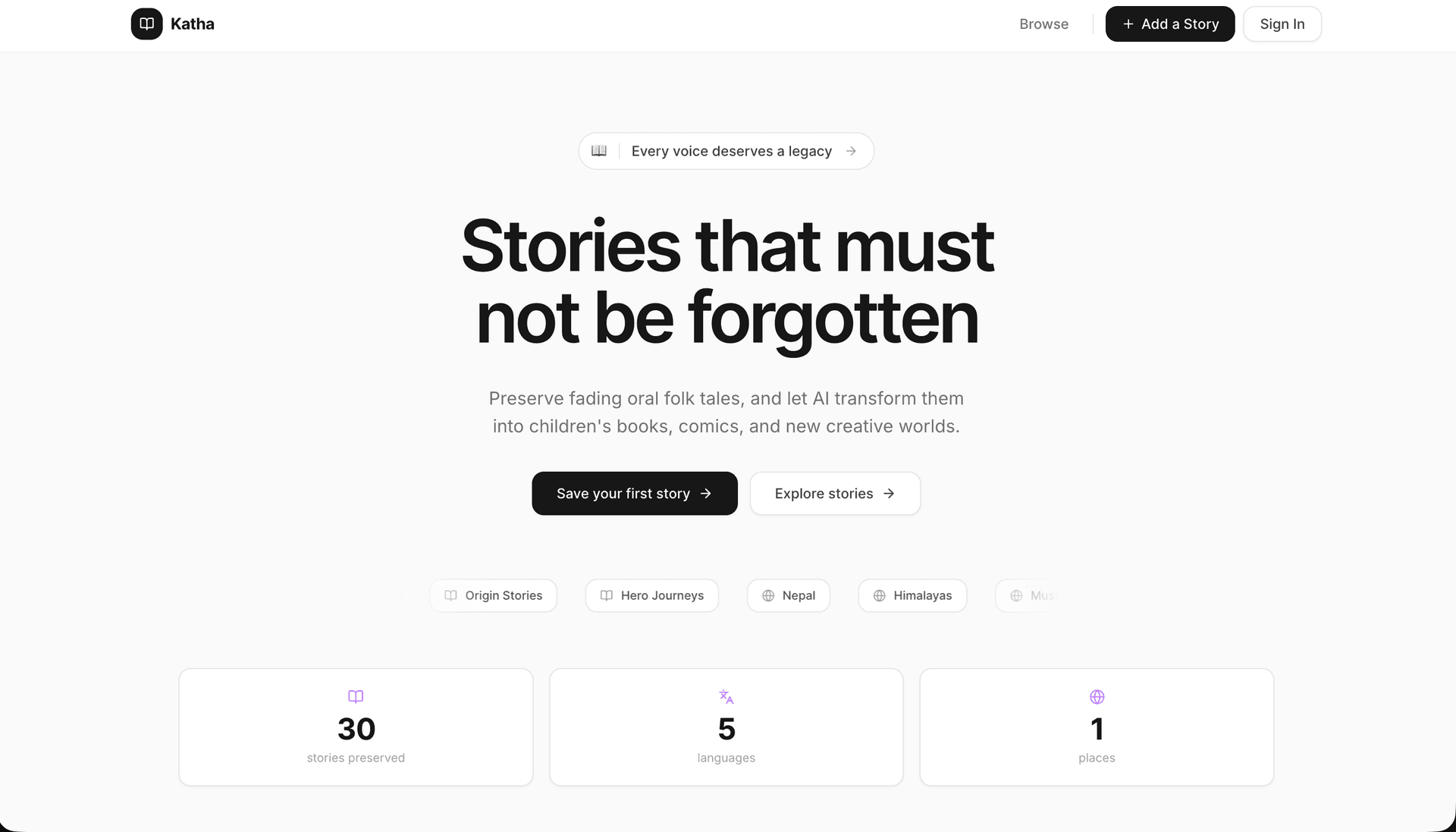
Interactive preview
Load the live project directly on this page. Requires an active deployment.
Interactive preview available
Loads the live site inside this page. Click to activate — the project must be publicly accessible.
Explore the build
Live demo and source code
Review the current interface or inspect the repository and documented implementation.